
A Colorado DUI involving property damage can create several legal issues at the same time. You may face a DUI, DUI per se, or DWAI allegation, possible traffic charges connected to the crash, restitution for qualifying losses, insurance claims, and a separate Colorado DMV process. If you left the scene or struck unattended property, Colorado crash-reporting and identification duties can also become part of the case.
Property damage alone does not make a Colorado DUI a felony. The level of the charge depends on facts such as qualifying prior convictions, whether anyone suffered serious bodily injury or died, whether you remained at the scene, and what the evidence shows about how the crash happened.
Property damage alone does not automatically turn a Colorado DUI into a felony. The state still has to prove every charged offense.
Hebets & McCallin P.C. represents people facing DUI and DWAI allegations in Denver, Colorado, and throughout the state. The defense review can include both the impairment evidence and the collision evidence.






Does Property Damage Make a DUI a Felony in Colorado? 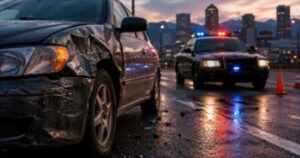
No. Property damage by itself does not automatically make a Colorado DUI a felony.
Under Colorado law, DUI, DUI per se, and DWAI are misdemeanors. A DUI, DUI per se, or DWAI can be treated as a class 4 felony when the current violation occurs after three or more qualifying prior convictions arising from separate and distinct criminal episodes. Those qualifying convictions can include DUI, DUI per se, DWAI, DUI-related vehicular assault, DUI-related vehicular homicide, or a combination of those offenses.
A crash involving serious bodily injury or death can also lead to separate felony allegations, including vehicular assault or vehicular homicide, when the statutory requirements are met.
The distinction matters because a DUI crash is not automatically a felony. Prosecutors must evaluate the driving record, the nature of the collision, injuries, chemical testing, witness statements, video, physical evidence, and other facts before deciding which charges to pursue.
For more information about Colorado impaired-driving allegations, visit:
https://www.hebetsmccallin.com/frequently-asked-questions-about-duis/
Just like anything else, practice leads to proficiency. With over 35 years of combined experience, we've gathered extensive knowledge inside and outside the courtroom.

What Additional Charges Can Follow a DUI Property-Damage Crash?
A DUI involving a collision can produce more than one allegation from the same event. Depending on the evidence, prosecutors may consider charges involving careless driving, reckless driving, leaving the scene of a crash, or failing to comply with duties after striking unattended property.
Careless driving generally involves driving in a careless and imprudent manner without due regard for the road, traffic, and surrounding circumstances. Reckless driving requires proof of a wanton or willful disregard for the safety of people or property. A collision by itself does not establish either offense.
If you leave a crash scene or fail to provide required information, you can face a separate allegation. Colorado law sets different duties for crashes involving occupied vehicles, unattended vehicles, other property, highway fixtures, and traffic-control devices.
If you strike an unattended vehicle or other unattended property and cause damage, Colorado law requires you to stop and either locate and notify the owner or leave the required identifying information in a conspicuous place. The unattended-property statute also requires compliance with Colorado’s crash-reporting law. A violation of the unattended-property statute is a class 2 misdemeanor traffic offense.
What Should You Do After a Property-Damage Crash?
You should stop and comply with Colorado crash-scene duties. You should not leave before completing the duties that apply to the type of collision involved.
If another occupied vehicle is involved, you generally must stop and provide the required identifying and vehicle information. If someone is injured, you may also have a duty to provide reasonable assistance.
Colorado’s crash-reporting statute requires a driver involved in a traffic crash that causes injury, serious bodily injury, death, or any property damage to give immediate notice to the nearest authorized police authority after completing the applicable duties at the scene.
What happens immediately after the collision can also become evidence in a DUI case. Officers may document:
- Where the vehicles stopped
• What you and other people said
• Whether anyone reported an injury
• Whether alcohol containers or other items were visible
• The condition of the road and surrounding area
• The time between the reported driving, police contact, and chemical testing
• Your appearance, speech, balance, and behavior
If this is your first impaired-driving case, this resource explains more about what you may encounter:
https://www.hebetsmccallin.com/this-is-my-first-dui-or-dwai-what-should-i-expect/
Collin McCallin performed EXCELLENTLY with my case. He kept in consistent contact with me throughout and showed diligence and extreme care for what I was dealing with. He worked effectively with the district attorney to resolve my case, and I could not be more pleased with the work. Thanks again! - Tim W Working with Russell lifted a huge weight off of our shoulders and allowed my husband and me to get back to living our lives knowing we were in good hands. Russell is truly a genuine and caring person and my husband and I will forever be grateful for the hard work, empathy, and support Russell gave us with my case. His persistence and determination resulted in a full dismissal of all of the charges!" - AnonymousExcellent Attorney
The Best Choice
Can a Court Order Restitution for Property Damage?
Yes, but Colorado’s restitution rules changed on August 12, 2026.
Restitution can still be ordered for qualifying losses that were proximately caused by the criminal conduct. The current law generally excludes losses for which a victim may be compensated through a private insurance policy. A court may still award restitution for a victim’s insurance deductible, and uninsured or otherwise qualifying out-of-pocket losses may still be considered when they meet the statutory requirements.
Depending on the facts and available insurance, restitution issues may involve:
- An insurance deductible
• Uninsured vehicle repair or replacement costs that qualify under Colorado law
• Qualifying towing or storage expenses
• Uninsured damage to a fence, building, sign, mailbox, or other property
• Other documented out-of-pocket losses that are legally recoverable and proximately caused by the criminal conduct
An insurer generally cannot use the criminal restitution process to recover covered losses based only on its contractual relationship with the insured. The law still allows an insurer to pursue civil remedies for losses it paid, subject to applicable law.
Restitution is different from a criminal fine. A fine is a criminal penalty paid to the government. Restitution is intended to compensate a victim for qualifying financial losses tied to the criminal conduct.
A restitution request should not be accepted without review. Your attorney can examine invoices, photographs, repair records, ownership information, insurance records, deductibles, payments already made, and whether the claimed loss is legally connected to the offense.
A civil insurance claim can also proceed separately from the criminal case. The firm discusses that distinction here:
https://www.hebetsmccallin.com/civil-claim-as-a-result-of-dui/
What Evidence Matters When a DUI Involves a Crash?
A crash can create more evidence than a DUI investigation that begins with a routine traffic stop. That evidence can support the prosecution, but it can also challenge assumptions in a police report.
Evidence that may matter includes:
- Police body-camera and dash-camera video
• Photographs of the vehicles and damaged property
• Skid marks, debris, lane markings, and impact locations
• 911 calls and dispatch records
• Statements from drivers, passengers, property owners, and witnesses
• Home or business surveillance footage
• Vehicle event data and onboard electronic records
• Tow and impound records
• Breath or blood test records
• Field sobriety test observations
• Repair estimates, invoices, and insurance records
• Road, lighting, visibility, and weather conditions
Vehicle damage can help explain how a crash occurred, but damage alone does not prove impairment. A collision can result from distraction, limited visibility, another driver’s movement, road conditions, mechanical problems, or driving error. The prosecution still has to prove DUI and any separate charged offense beyond a reasonable doubt.
Can the Crash Be Used as Evidence of Impairment?
Yes. Prosecutors may use the crash as circumstantial evidence of impairment. They may argue that a collision, lane departure, failure to brake, or unusual driving pattern is consistent with impaired driving.
A crash does not settle the question of impairment. Your defense attorney can compare the officer’s theory with the physical evidence, witness statements, video, vehicle damage, road layout, and timing.
For example, witness accounts may conflict. Surveillance footage may show another vehicle entering your path. The damage pattern may not match the first description of the collision. Road conditions or visibility may also provide another explanation for what occurred.
Timing can be central when police arrive after the driving has ended. In that situation, the case may depend more heavily on witness observations, statements, and the timeline between the reported driving, police contact, and breath or blood testing.
What If Someone Reports an Injury After the Crash?
A case can become more serious if another person reports an injury after the collision.
DUI-related vehicular assault requires serious bodily injury and proof of the statutory elements. DUI-related vehicular homicide involves death and has its own statutory requirements. These offenses are separate from a standard impaired-driving allegation.
A later-reported injury does not automatically establish vehicular assault. Medical records, the type and severity of the injury, causation, the mechanics of the collision, and other evidence can become central to the case.
Colorado felony DUI based on prior convictions is also a separate issue. Colorado appellate decisions have held that the qualifying prior convictions are an element of felony DUI and must be proved beyond a reasonable doubt.
What About Your Driver’s License?
Your criminal DUI case and your Colorado DMV case are separate proceedings. A driver can face administrative license consequences tied to a chemical test result or refusal while the criminal case is still pending.
Do not assume that dealing with the crash, insurance company, or vehicle repairs takes care of the DMV side of the case. Read every notice from law enforcement and the Colorado Division of Motor Vehicles, keep copies of your paperwork, and pay close attention to any stated deadlines.
For more information about Colorado DUI license consequences, visit:
https://www.hebetsmccallin.com/do-you-lose-your-license-for-a-dui-five-things-to-know/
How Can a DUI Defense Attorney Help?
A defense review can separate the impairment allegation from the collision allegation and then examine where the evidence overlaps.
Depending on the facts, your attorney may review:
- Whether police had a lawful basis for the traffic stop, detention, or arrest
• Whether the state can prove who was driving
• Whether the breath or blood testing procedures were properly followed
• Whether the testing timeline affects the state’s theory
• Whether crash evidence supports the prosecution’s account
• Whether a careless-driving or reckless-driving allegation fits the evidence
• Whether a leaving-the-scene allegation matches the duties that applied
• Whether witness statements are consistent
• Whether video or vehicle data contradicts the police narrative
• Whether a restitution request is supported by current Colorado law
• Whether claimed property losses are documented and legally recoverable
A property-damage DUI case can involve criminal court, DMV proceedings, insurance claims, vehicle repairs, civil claims, and restitution questions at the same time. Reviewing each part separately can help you understand what the state must prove and what evidence may support your defense.
Speak With a Colorado DUI Defense Attorney
If you are facing a DUI or DWAI allegation after a property-damage crash in Colorado, early review of the evidence can help you understand the charges, deadlines, DMV issues, and defenses that may apply.
Hebets & McCallin P.C. represents clients in Denver, Colorado, and throughout the state. Call (303) 854-6006 to discuss the facts of your case with a Colorado DUI defense attorney.
This article is for general informational purposes only and is not legal advice. Every case is different. Speak with an attorney about your specific circumstances.
