
Fall football tailgates in Colorado can combine several hours of drinking with crowded parking lots, late kickoffs, heavy postgame traffic, and the mistaken feeling that you are sober enough to drive. Colorado does not have a separate tailgate DUI offense. The same DUI, DWAI, DUI per se, chemical testing, and driver’s license rules can apply when you drive away from a stadium, watch party, bar, or home gathering.
If you are arrested after a football game or tailgate, the case can involve much more than a breath or blood number. The reason for the stop, body-camera footage, traffic conditions, roadside testing, chemical testing procedures, and the separate Colorado DMV process can all affect how your case should be evaluated.
Hebets & McCallin P.C. represents people facing DUI and DWAI allegations in Denver and throughout Colorado. The firm’s attorneys are former prosecutors with experience handling Colorado criminal defense and DUI matters.






Why Football Tailgates Can Create DUI Risk 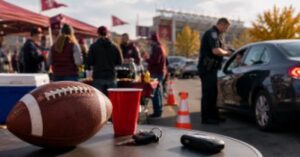
Tailgating can make alcohol consumption difficult to track. You may have one drink while setting up, another with food, and more during a game that lasts several hours. When the crowd starts leaving, you may feel alert enough to drive even though alcohol remains in your bloodstream.
Postgame driving around Denver can involve pedestrians, rideshare pickups, buses, temporary traffic controls, sudden stops, and unfamiliar routes. Those conditions do not excuse impaired driving, but they can provide context when an officer describes braking, lane movement, or hesitation as possible signs of impairment.
A traffic stop still requires a lawful basis. An officer may report speeding, weaving, an unsafe turn, an equipment issue, or another traffic violation. After approaching your vehicle, the officer may expand the investigation if the officer reports an odor of alcohol, red or watery eyes, unusual speech, coordination problems, open containers, or statements about drinking.
For more information about Colorado impaired-driving cases, visit:
https://www.hebetsmccallin.com/denver-dui-lawyers/
Just like anything else, practice leads to proficiency. With over 35 years of combined experience, we've gathered extensive knowledge inside and outside the courtroom.

Colorado DUI, DWAI, and DUI Per Se After a Tailgate
Colorado Revised Statutes section 42-4-1301 recognizes several impaired-driving theories.
DUI applies when alcohol, one or more drugs, or a combination affects you to a degree that makes you substantially incapable of exercising clear judgment, sufficient physical control, or due care in the safe operation of a vehicle.
DWAI applies when alcohol, one or more drugs, or a combination affects you to the slightest degree so that you are less able than usual to exercise clear judgment, sufficient physical control, or due care.
DUI per se focuses on alcohol concentration. You can face a DUI per se allegation when the prosecution claims your blood alcohol concentration, commonly called BAC, was 0.08 or more at the time of driving or within two hours after driving, subject to Colorado’s proof and defense rules.
If your BAC is more than 0.05 but less than 0.08, Colorado law permits an inference that your ability to operate a vehicle was impaired by alcohol. A BAC below 0.08 does not automatically prevent a DWAI or DUI allegation. Police and prosecutors may also rely on driving behavior, statements, roadside exercises, video, witness observations, and other evidence.
For a closer comparison of DUI and DWAI, visit:
Game-Day Traffic Can Affect How Your Driving Is Interpreted
Consider a driver leaving a crowded Denver football gathering. A pedestrian steps between two parked cars. The driver brakes sharply, moves within the lane, and then slows while looking for an exit. An officer sees only part of that sequence and starts a traffic stop.
Those facts do not create a defense by themselves. They show why context matters. Dash-camera video, nearby surveillance footage, witness statements, traffic-camera recordings, parking records, and the location itself may help explain whether the driving behavior had a cause unrelated to alcohol.
Your attorney can compare the officer’s written report with available video and other evidence. A recording may show traffic, pedestrians, road conditions, or driving details that do not appear in the report.
Collin McCallin performed EXCELLENTLY with my case. He kept in consistent contact with me throughout and showed diligence and extreme care for what I was dealing with. He worked effectively with the district attorney to resolve my case, and I could not be more pleased with the work. Thanks again! - Tim W Working with Russell lifted a huge weight off of our shoulders and allowed my husband and me to get back to living our lives knowing we were in good hands. Russell is truly a genuine and caring person and my husband and I will forever be grateful for the hard work, empathy, and support Russell gave us with my case. His persistence and determination resulted in a full dismissal of all of the charges!" - AnonymousExcellent Attorney
The Best Choice
Field Sobriety Exercises After a Long Game Day
An officer may ask you to perform roadside coordination exercises, including the walk-and-turn, one-leg stand, and horizontal gaze nystagmus test.
Your performance can be affected by circumstances other than alcohol. Uneven pavement, footwear, injuries, fatigue, passing traffic, flashing lights, anxiety, and unclear instructions can influence what an officer observes.
A defense review may examine whether the officer gave and demonstrated the instructions correctly, whether the testing surface was suitable, whether the officer recorded the claimed clues accurately, and whether body-camera footage matches the written report.
For more information about roadside testing, visit:
https://www.hebetsmccallin.com/denver-field-sobriety-test-attorneys/
Breath Tests, Blood Tests, and Refusals
Chemical testing can become a central issue after a tailgate-related DUI arrest. The reported BAC matters, but the circumstances surrounding the test can matter as well.
A defense attorney may review the time between driving, arrest, and testing. Breath-test cases can involve instrument records, maintenance, certification, operator procedures, and testing documentation. Blood-test cases can involve collection, storage, transport, chain of custody, laboratory methods, and timing.
An alleged refusal can create separate driver’s license consequences. A case review may examine what the officer said, how the request was made, whether you understood the request, whether a medical or communication issue affected the exchange, and what any available video shows.
For more information about refusal allegations, visit:
https://www.hebetsmccallin.com/you-refused-a-blood-or-breath-test-what-now/
The Colorado DMV Deadline Can Arrive Quickly
A Colorado DUI arrest can create two separate proceedings. Your criminal case goes through the court system. The administrative case involving your driving privilege goes through the Colorado Division of Motor Vehicles.
The DMV hearing deadline can arrive before much happens in the criminal case.
You generally have seven days to request a DMV hearing when:
- You took a breath test at the time of the stop.
- You refused a breath or blood test at the time of the stop.
- You receive notice of blood-test results after a blood draw.
A future court date does not preserve your separate DMV hearing right. Read every document you receive from law enforcement, the court, and the DMV as soon as possible.
If this is your first allegation, visit:
https://www.hebetsmccallin.com/denver-first-offense-dui-lawyers/
Potential Penalties for a First Colorado DUI or DWAI
A football game does not create separate sentencing rules. The possible consequences depend on the charge, your record, BAC, aggravating facts, and other circumstances.
For a first DUI or DUI per se conviction, Colorado law provides for:
- 5 days to 1 year in county jail
- A $600 to $1,000 fine
- 48 to 96 hours of useful public service
- Possible probation
- Alcohol and drug evaluation, education, or treatment requirements
- Separate driver’s license consequences
Colorado law allows the five-day minimum jail term to be suspended when statutory evaluation, education, and treatment conditions are satisfied. If your BAC was 0.20 or higher at the time of driving or within two hours after driving, the law provides for at least 10 days and up to one year in county jail, with sentencing alternatives available in qualifying circumstances.
For a first DWAI conviction, Colorado law provides for:
- 2 to 180 days in county jail
- A $200 to $500 fine
- 24 to 48 hours of useful public service
- Possible probation
- Alcohol and drug evaluation, education, or treatment requirements
Prior qualifying impaired-driving convictions can increase the sentencing exposure. A DUI, DUI per se, or DWAI offense can become a class 4 felony when it occurs after three or more qualifying prior convictions arising from separate criminal episodes.
These ranges do not predict the result of your case. The outcome depends on the evidence, your history, the charge, and the facts presented in court.
What Evidence Can Help in a Tailgate DUI Defense?
A useful defense review often starts with a timeline. Your attorney may ask when you arrived, what you drank, when you drank it, when the gathering ended, when you started driving, when police made contact, and when a breath or blood sample was collected.
Evidence that may matter includes:
- Police reports
- Body-camera footage
- Dash-camera footage
- Receipts
- Photographs and tailgate videos
- Parking records
- Phone location information
- Witness names and statements
- Breath-testing records
- Laboratory documents
- Relevant medical information
- Surveillance or traffic-camera footage
Your attorney may also examine whether the officer had a lawful basis for the stop, whether probable cause supported the arrest, whether roadside testing was administered fairly, whether chemical testing procedures were reliable, and whether the prosecution can connect its evidence to the time you were driving.
An arrest is not a conviction. The prosecution must still prove the charged offense under the applicable legal standard.
Planning Ahead for the Next Colorado Football Weekend
The safest way to avoid a tailgate DUI is to decide how you will get home before drinking begins.
You can:
- Choose a designated sober driver.
- Arrange a rideshare or taxi before kickoff.
- Use available public transportation.
- Stay nearby when practical.
- Set a pickup plan before the event begins.
- Leave your vehicle parked when you are uncertain whether you are safe to drive.
Food, coffee, cold air, a short nap, or the feeling that you are fine does not establish that alcohol has left your body. If you are uncertain whether you can drive safely, do not drive.
Speak With a Colorado DUI Defense Attorney
If a football tailgate or watch party ends with a DUI or DWAI arrest, an early case review can help you identify court dates, DMV deadlines, testing issues, video evidence, and possible defenses.
Hebets & McCallin P.C. handles DUI and criminal defense matters in Denver and throughout Colorado. The firm’s attorneys are former prosecutors and have more than 35 years of combined experience.
Call 303-854-6006 or visit:
https://www.hebetsmccallin.com/contact-us/
This article is for informational purposes only and is not legal advice. Speak with an attorney about the facts of your situation.
